How to Stop Managing Every Detail Yourself


To stop managing every detail yourself, the owner has to stop being the default answer for every decision, correction, approval, and daily problem.
Many owners think they are protecting the business by staying close to every detail. They check the floor, approve small decisions, follow up with vendors, correct staff, handle complaints, review supplies, notice broken equipment, and answer questions that should already have clear owners.
At first, this can feel responsible. The owner cares. The owner sees problems. The owner does not want standards to fall.
But over time, this creates a different problem.
The business starts depending on the owner’s personal attention instead of depending on roles, standards, systems, and accountability. Every detail may still get handled, but only because one person keeps carrying the weight.
If the owner or CEO is thinking about opening the next location while also checking the floor, solving small staff issues, approving routine expenses, and correcting daily operational gaps, one of those responsibilities will suffer.
There are only twenty-four hours in a day. Productive hours are even fewer. A business cannot grow seriously if the most important person in the company is trapped inside every small operational detail.
If every detail depends on the owner’s personal attention, the owner is not protecting quality. The owner is becoming the bottleneck.
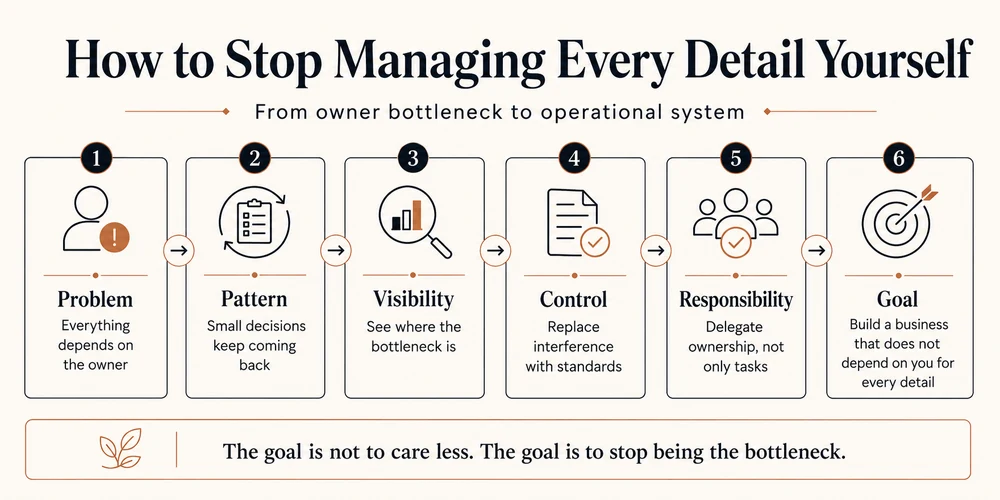
How to Stop Managing Every Detail Yourself Without Losing Control
The goal is not to stop caring. The goal is to stop being the only person who notices, decides, corrects, approves, and follows up.
This distinction matters because many owners confuse delegation with weakness. They think stepping back means lowering standards. They worry that if they do not personally check everything, the business will become sloppy.
But strong delegation is not the absence of control. It is a better form of control.
Instead of controlling every action directly, the owner controls the system: who owns each area, what standard is expected, what decisions can be made without approval, what must be escalated, and how results are reviewed.
This is the difference between a business that runs through personal energy and a business that runs through management structure.
You Cannot Grow While Holding Every Detail Yourself
A business can survive for a while when the owner personally carries every detail. Many small businesses begin this way. The owner knows everything, sees everything, and handles everything because there is no real team yet.
But what works at the beginning becomes dangerous later.
As the business grows, the number of small details grows with it. More clients create more questions. More staff create more coordination. More equipment creates more maintenance. More vendors create more follow-up. More revenue creates more financial decisions. More standards create more accountability needs.
If all of that still goes through one person, the company does not become more mature. It becomes more dependent.
The owner may feel busy all day, but being busy is not the same as leading. A full calendar does not prove that the business is being managed well. Sometimes it proves the opposite: the system is weak, so the owner has to keep filling the gaps personally.
The hard question is not “How much am I doing?” The better question is “Why does this still depend on me?”
When Help Becomes a Pattern of Dependency
Helping the team is not the problem. Every owner will sometimes step in, solve a problem, answer a question, or support an employee.
The problem starts when help becomes a pattern of dependency.
Staff wait for approval because they do not know what they are allowed to decide. Managers bring every small issue back to the owner because ownership was never clearly defined. Specialists are hired, but their recommendations are ignored or delayed. Vendors cannot move forward because no one else has authority. Small questions repeat every week because the system never learns.
At that point, the owner is no longer only helping. The owner has become the operating system.
- Every problem comes back to the owner.
- Every decision waits for the owner.
- Every unclear role becomes the owner’s responsibility.
- Every weak standard requires the owner’s personal correction.
- Every staff hesitation becomes another interruption.
This pattern is exhausting, but exhaustion is only one part of the issue. The deeper problem is that the business cannot move faster than the owner’s available attention.
A business cannot scale when the owner is the approval point for everything.
Make the Bottleneck Visible First
Before an owner can delegate properly, the bottleneck has to become visible.
Many owners try to solve the problem by telling themselves they need to “delegate more.” But that is too vague. Delegation only works when the owner understands where responsibility is unclear, where authority is missing, and where the same decisions keep returning.
The first step is to look at the pattern honestly.
- Which questions keep coming back to the owner?
- Which decisions cannot move without approval?
- Which employees have responsibility but no real authority?
- Which specialists are being paid for expertise but blocked from using it?
- Which problems repeat because nobody truly owns them?
- Which areas depend on memory instead of a visible system?
This visibility matters because the owner may think the problem is staff weakness, but sometimes the real problem is unclear structure.
People cannot take ownership if they do not know where ownership begins and ends. They cannot make decisions if every decision is treated as risky. They cannot be accountable for results if they are only allowed to follow instructions.
Visibility turns frustration into something that can be fixed.
Control Should Come From Standards, Not Constant Interference
Control does not have to mean constant interference.
In weak delegation, the owner gives a task but keeps the real authority. The employee is told to handle something, but must ask before every step. The owner still approves every detail, changes decisions mid-process, corrects without clear criteria, and remains the final point for everything.
That is not real delegation. That is task assignment with owner dependency still attached.
Stronger delegation sounds different.
- This is your area.
- This is the standard.
- This is the budget limit.
- This is what you can decide without approval.
- This is when you escalate.
- This is how we review the result.
That structure gives employees room to act while still protecting the business.
The owner does not disappear. The owner changes the control mechanism. Instead of interrupting every action, the owner builds standards, reporting, escalation rules, review habits, and accountability.
This is how the business becomes less dependent on personal supervision without becoming uncontrolled.
Delegate Responsibility, Not Only Tasks
Many owners think they are delegating because they give tasks to employees. But tasks are not the same as responsibility.
A task is temporary. Responsibility is ongoing.
“Please call this vendor” is a task. “You own maintenance follow-up for this area, including vendor communication, status updates, and escalation when cost or timing exceeds the agreed limit” is responsibility.
“Check the locker room” is a task. “You are responsible for locker room standards during your shift, including supplies, cleanliness, issue reporting, and escalation when something cannot be solved immediately” is responsibility.
This difference changes how people behave.
When employees receive only tasks, they wait for the next instruction. When they receive responsibility, they begin to think about outcomes.
The business needs people who do not only complete instructions, but also notice problems, understand standards, make appropriate decisions, and follow through.
That is why delegation has to include ownership, not just workload transfer.
Hire Specialists, Then Let Them Work
One of the most expensive mistakes in business is hiring specialists and then refusing to let them use their judgment.
An owner may hire an operations manager, accountant, lawyer, marketing specialist, maintenance lead, consultant, or experienced staff member because that person knows more about a specific area. But after hiring them, the owner may still override every recommendation, delay decisions, or force the specialist to work around personal preferences instead of professional judgment.
This damages the business in two ways.
First, the company pays for expertise but does not receive the full value of that expertise. Second, strong employees eventually stop thinking deeply because they learn that their recommendations will not matter.
Hiring a specialist and then blocking their professional judgment is a form of business self-sabotage.
This does not mean every recommendation must be accepted automatically. The owner still has to ask questions, understand risk, review cost, and protect the business. But if a specialist was hired for a specific area, that person needs enough trust and authority to actually perform the work.
If the owner wants every decision to remain personal, then the company is not really building a team. It is building a group of assistants around one decision-maker.
Trust Needs Boundaries, Reporting, and Review
Trust does not mean blind faith.
Some owners resist delegation because they believe trust means losing control. But proper trust is not emotional guessing. It is built through boundaries, reporting, and review.
A good system does not say, “Do whatever you want.” A good system says, “This is your area, this is the standard, this is your decision range, this is what must be reported, and this is how we evaluate the result.”
That gives the employee freedom inside a structure.
For example, a manager may be allowed to adjust small schedule gaps without owner approval, but must report major coverage risks. A maintenance lead may be allowed to contact a vendor for routine follow-up, but must escalate when cost exceeds a set amount. Front desk staff may be allowed to solve small client situations within clear rules, but must escalate sensitive complaints, safety issues, legal concerns, or repeated patterns.
This is not weak control. This is mature control.
The owner still sees what matters, but does not have to personally touch every small step.
If There Is No Trust, Solve That Problem Honestly
If the owner cannot trust someone with their own area of responsibility, the situation needs to be addressed honestly.
There are usually only a few explanations.
The person may not be the right fit. The person may need training. The role may be unclear. The standard may not be documented. The owner may not have given enough authority. Or the owner may simply not know how to delegate without interfering.
What does not work is keeping someone in a role while blocking every decision they try to make.
That creates frustration on both sides. The employee feels powerless. The owner feels unsupported. The business remains dependent on personal control.
If the employee is not capable, the owner needs to train, replace, or restructure the role. If the employee is capable but the owner keeps interfering, then the owner has to solve the delegation problem internally.
A business cannot build responsibility while treating every responsible person as untrustworthy.
Staff Should Bring Options, Not Only Problems
One of the practical ways to reduce owner dependency is to change how problems are brought forward.
In a weak system, staff bring only the problem.
- The machine is broken.
- The client complained.
- The vendor did not respond.
- The cleaner missed something.
- The schedule has a gap.
- The supplies are low.
Those problems may be real, but they still push thinking back onto the owner.
In a stronger system, staff bring the problem, the options, the recommended decision, and what support is needed.
This changes the culture of the business. People stop acting only as messengers and start becoming problem-solvers.
The owner can still make the final call when necessary, but the team begins to develop judgment. Over time, fewer issues require personal involvement because employees learn how decisions are made.
This is one of the practical differences between daily firefighting and operational control.
In a Gym, Small Details Still Need Owners
In a gym, details matter. The answer is not to ignore them.
Broken equipment, cleaning checks, locker room supplies, front desk situations, access issues, schedule gaps, vendor follow-ups, maintenance notes, client complaints, and safety concerns all affect the member experience.
The issue is not that these details are too small for management. The issue is that they should not live only in the owner’s head.
Each recurring area needs an owner, a standard, and a follow-up process.
Equipment issues should be reported, tracked, assigned, and reviewed. Cleaning standards should be checked by role, not by luck. Supplies should have a responsible person and a reorder routine. Staff schedule gaps should have clear decision rights. Client issues should have escalation rules. Vendor follow-ups should not depend on whether the owner remembers to ask.
This is where a stronger gym staff training system becomes important. Staff need more than general instructions. They need routines, standards, and accountability that match the level of experience the gym wants to deliver.
Good management does not remove attention from details. It gives details a structure.
Systems Protect the Owner From Becoming the System
When there is no system, the owner becomes the system.
The owner remembers what is broken. The owner remembers who should follow up. The owner remembers which vendor was called. The owner remembers which staff member needs correction. The owner remembers which issue happened before.
This may work for a short time, but it is fragile.
Memory is not a management system. Personal attention is not a scalable process. Constant checking is not the same as accountability.
A stronger system makes important information visible to the right people. It shows what happened, who owns it, what the next step is, when follow-up is due, and when escalation is required.
This does not have to be complicated. A simple tracker, a shift checklist, a maintenance log, a vendor follow-up sheet, a staff communication routine, or a weekly review can already reduce dependency on the owner.
The point is not to create paperwork for its own sake. The point is to stop using the owner’s mind as the only place where operations are organized.
Operational Control Also Requires Budget Clarity
Delegation becomes difficult when employees have responsibility but no budget clarity.
If every small expense requires owner approval, even basic follow-up becomes slow. Staff may see a problem, know the solution, and still wait because they are unsure what they are allowed to approve.
This is especially common in facility-heavy businesses like gyms, where maintenance, supplies, cleaning, repairs, vendors, and equipment issues all create recurring decisions.
The answer is not unlimited spending authority. The answer is clear limits.
A manager may have authority up to a certain amount. A maintenance issue may require approval only above a threshold. Routine supplies may follow a set reorder process. Vendor work may be separated into basic follow-up, approved repairs, and major cost decisions.
This connects directly to gym operational cost optimization. Cost control is not only about reducing expenses. It is also about making sure the right people can act within clear financial boundaries.
When budget rules are unclear, delegation becomes hesitation. When budget rules are clear, people can move without turning every small decision into an owner interruption.
The Owner’s Role Is to Design the System
As the business matures, the owner’s role has to change.
The owner should not be the person who personally touches every detail. The owner should be the person who makes sure the business has the right people, roles, standards, routines, reporting, decision rights, and accountability to handle those details consistently.
That is a higher level of responsibility, not a lower one.
Doing every detail yourself may feel responsible because it is visible work. Designing the system is less visible, but it is more important for growth.
A business becomes stronger when the owner can step away from a detail and still trust that the process will work. Not because people are perfect, but because the structure is clear enough to catch problems, correct mistakes, and keep responsibility visible.
This is how the owner moves from constant involvement to real operational leadership.
The Goal Is Not to Care Less
The goal is not for the owner to care less. The goal is for the business to stop depending on the owner’s personal attention for every detail.
Caring about standards is good. Caring about clients is good. Caring about staff performance, facility quality, cost control, and daily execution is necessary.
But care has to become structure.
If the owner is the only person who notices, decides, corrects, follows up, and remembers, the business remains trapped inside one person’s capacity.
A stronger business distributes responsibility without losing standards. It gives people clear roles, clear limits, clear reporting, and real ownership.
A business becomes stronger when responsibility is no longer trapped inside one person.
Still Managing Every Detail Yourself?
Build an Operation That Does Not Depend on Your Constant Attention
If routine decisions, staff questions, vendor follow-up, and daily facility issues still return to you, I can help clarify ownership, decision rights, reporting, and the practical systems needed for stronger control.
No pressure. The first conversation is used to understand the situation and determine whether the project is a practical fit.