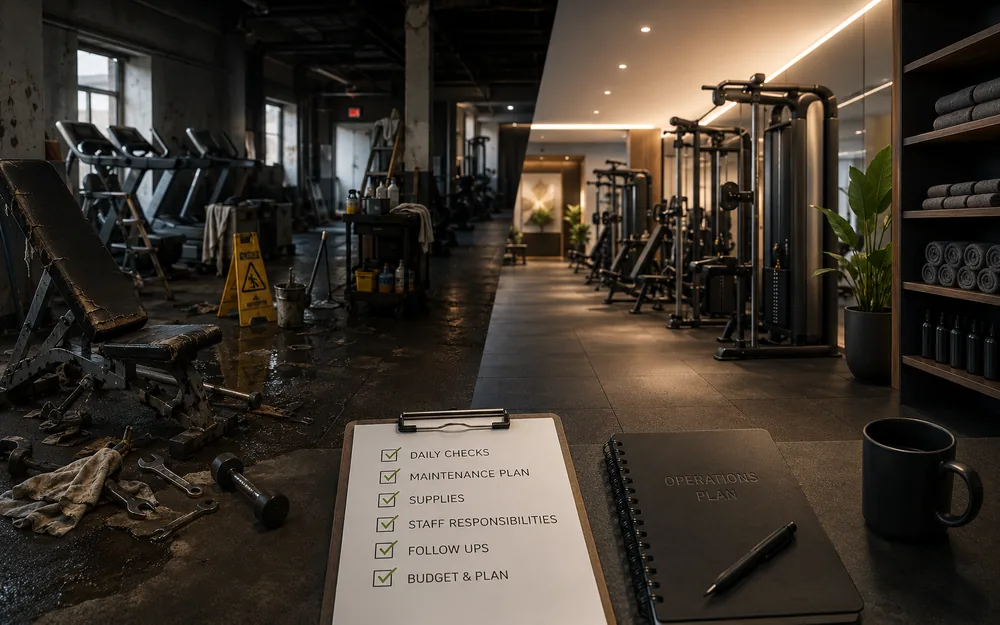
Why Small Gym Problems Become Big Client Reactions


Small gym problems usually do not become big client reactions because of one isolated issue. They become serious when the client starts seeing a pattern.
Every gym has problems. Equipment breaks. Staff members miss details. Supplies run low. Locker rooms need attention. Small facility issues appear during the day even in a well-managed club.
None of this automatically destroys trust.
The real question is not whether small problems happen. The real question is whether the gym has a system to see them early, fix them quickly, communicate clearly, and prevent the same issues from repeating.
Small gym problems become big client reactions when they repeat, overlap, or make the club feel uncontrolled.
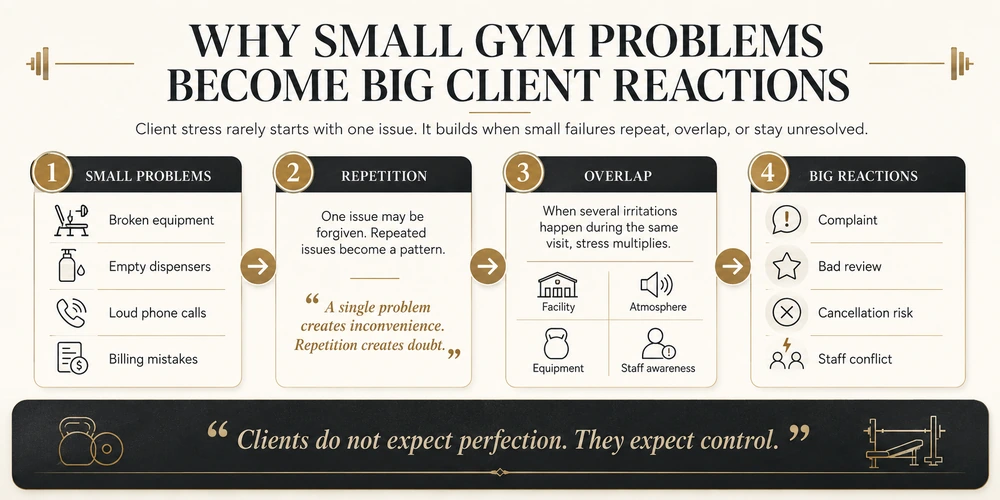
Clients Do Not Expect Perfection
Clients usually understand that real facilities are not perfect. A sink can get clogged. A shower can have a temporary issue. A machine can break. A dispenser can run out.
If the issue is isolated, visible to staff, and handled quickly, many clients will move on. They may not like the inconvenience, but they can still feel that the gym is under control.
The problem starts when the same issue keeps coming back.
One clogged sink may be a facility issue. A clogged sink every other day is an operations issue.
This difference matters. A one-time inconvenience can be forgiven. A repeated inconvenience becomes evidence. It tells the client something about how the gym is being managed.
How Small Problems Become Big Reactions
The Last Problem Is Not Always the Real Problem
Staff often sees the final moment. A client complains about an empty dispenser, a broken machine, a cold locker room, or a loud phone call. From the outside, the reaction may look too strong.
But the client may not be reacting only to that one moment. They may be reacting to a chain of small problems that have been building for several visits.
Maybe they received a confusing billing message earlier that day. Maybe the locker room was uncomfortable. Maybe the shower area did not feel clean. Maybe the same machine was still out of order. Maybe the music did not match the vibe of the club. Maybe another client was talking loudly on the phone.
Then one more small issue appears, and that issue becomes the point where the stress becomes visible.
The complaint may start at the front desk, but the real problem may have been building for days or weeks.
Repetition Changes the Meaning of a Problem
A single problem can feel like bad luck. A repeated problem feels like a pattern.
This is one of the most important ideas in gym operations. Clients judge the club not only by whether problems happen. They judge the club by whether the same problems keep happening without visible follow-up.
- One day without hot water may be a technical issue.
- Regular hot water problems become a trust issue.
- One empty dispenser may be a missed detail.
- Empty dispensers every week show a weak routine.
- One loud phone call may be random.
- Constant loud phone calls make the environment feel unmanaged.
Repetition changes the meaning of the problem. It moves the issue from accident to pattern. Once clients see a pattern, they start questioning the whole system behind the gym.
Small Problems Become Bigger When They Overlap
One small issue may not create a strong client reaction. Several small issues during the same visit can change the entire experience.
Clients do not experience the gym as separate maintenance tickets. They experience one complete visit. The entrance, locker room, equipment, staff, temperature, smell, music, billing, and atmosphere all blend together.
If several of those areas feel weak at the same time, the client may react to the last problem even though the stress came from the whole visit.
That is why client reactions can look sudden. The reaction may happen in one moment, but the stress often comes from several signals arriving too close together.
Gym client stress is often not caused by one issue. It builds when small problems repeat, overlap, or stay unresolved.
Facility and Equipment Problems Have a Time Limit
Facility Problems Feel Personal
Facility problems affect the body. That is why clients feel them strongly.
No hot water is not just a technical issue. A dirty shower is not just a cleaning issue. Bad smells are not just a small detail. A locker room that is too cold or too hot can change the whole visit.
Clients use the gym physically. They sweat, shower, change clothes, touch equipment, use restrooms, and move through shared spaces. When basic comfort is missing, the experience becomes frustrating quickly.
This matters even more in a premium or neighborhood premium gym. In that type of club, clients are not paying only for machines. They are paying for comfort, cleanliness, order, and predictability.
Shower and locker room problems are part of the daily experience, which is why Men’s Shower Room Renewal can directly affect client trust before and after the workout.
Broken Equipment Has a Time Limit
Equipment breaks in every gym. That is normal.
But broken equipment has a time limit in the client’s mind. The longer a machine stays out of order, the less it feels like a repair issue and the more it feels like a management issue.
This is especially true when the machine is popular. A client may understand that a machine is down today. After a week, the same client may start asking why nothing has changed. After several weeks, the machine can start to look forgotten.
A broken machine is understandable. A forgotten broken machine is not.
This is why equipment modernization is more than a cosmetic upgrade. It reduces repeated frustration, lowers repair pressure, and shows clients that the gym is moving forward instead of letting visible problems sit in the open.
Billing and Atmosphere Can Damage Trust Quickly
Billing Stress Can Damage Trust Quickly
Money problems create stress faster than many facility problems.
A wrong balance reminder, an unexpected price change, a confusing charge, or a mistake in membership status can feel personal to the client.
Even if the mistake is small, the emotional effect can be large. The client may start wondering whether the gym is organized, whether the billing system is accurate, and whether they are being treated fairly.
Billing mistakes are not only administrative errors. They can become trust problems.
Atmosphere Also Creates Stress
A gym is not only a room with equipment. It is a shared environment.
Music, noise, behavior, crowding, smell, lighting, and etiquette all shape the feeling of the club. Clients may not mention these details every time, but they still feel them.
One loud phone call may not matter. Constant loud phone calls can make the gym feel less controlled. One person behaving outside the expected standard may be random. A repeated pattern of weak etiquette changes the atmosphere of the club.
This does not mean management should attack clients or create a harsh environment. It means the gym needs clear standards for the kind of shared experience it wants to protect.
Staff Awareness Is Part of the Experience
Staff members are often not the cause of the problem. But they are the face of the system.
When clients see empty dispensers, dirty areas, bad smells, loud behavior, broken equipment, or unclear communication, they often look at staff first.
This does not mean staff should be blamed for everything. It means staff need routines, support, and clear steps so small problems do not disappear between shifts.
- Staff should know what to check during the day.
- Staff should know how to report recurring problems.
- Staff should know when an issue needs escalation.
- Staff should know what to say when something is being fixed.
A stronger staff training system helps small problems get noticed, documented, and escalated before they become larger complaints.
Read Client Reactions as Operations Signals
Do Not Blame the Client Too Quickly
It is easy to label someone as a difficult client when they react strongly. Sometimes the client may be difficult. Some situations are not reasonable.
But management should be careful before making that conclusion too quickly.
A strong client reaction may be information. It may show that too many small problems have been allowed to repeat, overlap, or remain invisible for too long.
The goal is not to say the client is always right. The goal is to understand what the reaction is trying to reveal.
Client stress is often an operations signal, not just a complaint.
Clients Expect Control
Clients do not need a gym to be perfect. They need to feel that the gym is under control.
They need to see that problems are noticed. They need to feel that repairs are moving. They need to know that staff understands what is happening. They need to trust that the same issue will not be ignored again and again.
Control does not mean nothing ever goes wrong. Control means the gym has systems that catch problems early, assign responsibility, and prevent repeated issues from becoming part of the normal experience.
That is what separates a random bad day from a weak operation.
Small Problems Are Not Small When They Repeat
Small gym problems can look harmless at first. A broken machine, an empty dispenser, a cold locker room, a billing mistake, a loud environment, or a bad smell may seem like one small issue.
But if those issues repeat, overlap, or stay unresolved, they change how clients see the gym.
They stop seeing one problem. They start seeing a pattern.
And when clients see a pattern, they start asking bigger questions.
- Is this gym being managed well?
- Is my membership still worth it?
- Should I complain?
- Should I leave?
This is why small gym problems matter. They are not only small details. They are signals of the whole experience.
Control Matters More Than Perfection
Clients usually do not react strongly because of one small problem. They react when small problems start to tell a bigger story.
The story may be about weak maintenance. It may be about poor communication. It may be about staff awareness. It may be about facility standards. It may be about repeated issues that nobody seems to own.
A well-run gym does not depend on luck. It depends on systems that catch small failures early.
Because in a gym, small problems rarely stay small when clients see them again and again.
Are Small Problems Becoming a Pattern?
Restore Control Before Clients Lose Trust
If recurring maintenance, staffing, communication, or member-experience issues are creating complaints, I can help identify the operational pattern and build a practical system for stronger daily control.
No pressure. The first conversation is used to understand the situation and determine whether the project is a practical fit.