From Daily Firefighting to Operational Control

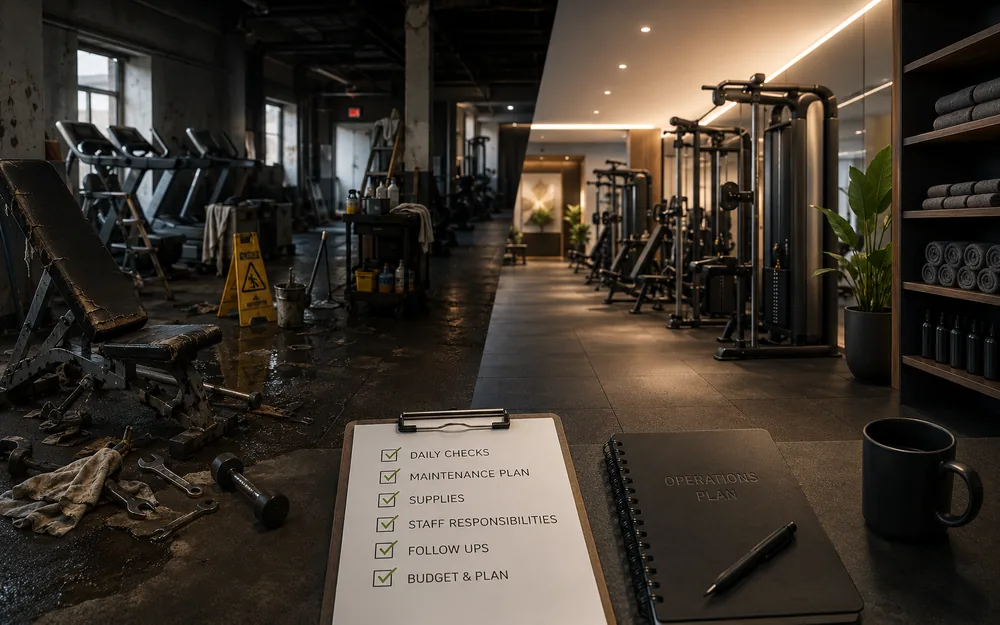
A gym does not become stronger by reacting to every problem as an emergency.
This is where operational control becomes important: the ability to see problems early, separate emergencies from patterns, and move issues into a clear management system.
Every gym has problems. Equipment breaks. Staff members miss details. Supplies run low. Vendors delay work. Customers complain. Locker rooms need attention. Small facility issues appear during the day.
None of this is unusual.
The real question is not whether problems happen. The real question is whether the gym has a system to see them, prioritize them, assign responsibility, and prevent the same issues from repeating.
When a gym does not have that system, management spends most of its time in daily firefighting. Every issue feels urgent. Every problem interrupts the day. Every complaint becomes a separate crisis.
Over time, this creates a dangerous pattern: the gym is always busy, but not always under control.
Reactive Management Is Not Always Bad Management
It is important to be fair about reactive work.
Sometimes a new manager walks into a facility where problems have been accumulating for years. Maintenance was delayed. Equipment was ignored. Cleaning standards were inconsistent. Staff responsibilities were unclear. Vendors were not followed up with. Budgets were not realistic. Customer complaints were handled one by one, but the root causes were never fixed.
In that situation, the first stage of work will often be reactive.
The manager may need to fix urgent repairs, respond to customer-facing issues, handle safety concerns, correct cleanliness problems, rebuild staff routines, and stabilize basic operations before deeper systems can be built.
Reactive work is not always a sign of weak management. The real test is whether management stays reactive or uses that stage to build operational control.
A new manager may have to start by putting out fires. But the goal should not be to live there forever.
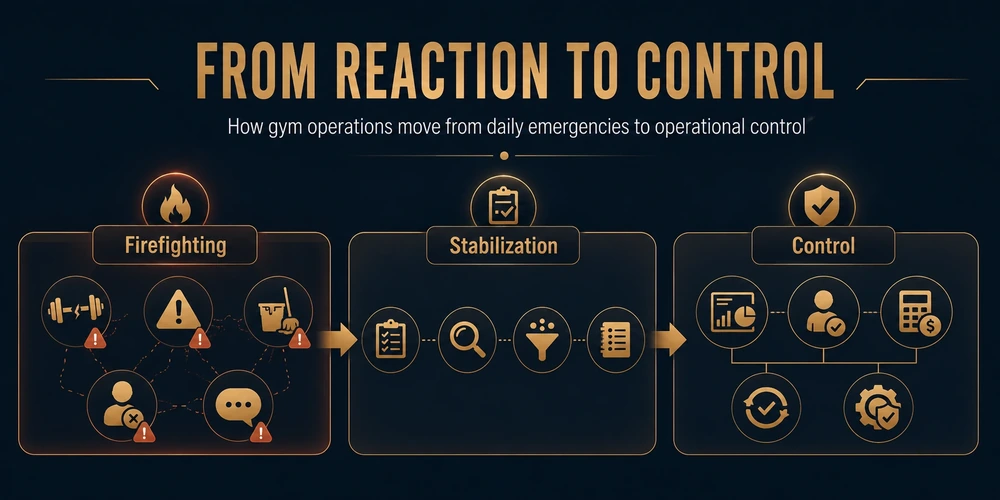
The goal is to move from emergency response to visibility, from visibility to systems, and from systems to control.
The Recovery Stage: Fix What Is Already Burning
The first stage is often recovery.
This is where management deals with the most urgent problems first. These are the issues that create safety risk, damage the member experience, interrupt the business, or make the facility look neglected.
- Broken equipment that can no longer be ignored.
- Locker room or shower problems that affect customer trust.
- Cleaning failures that are visible to members.
- Supply shortages that interrupt daily service.
- Staffing gaps that create pressure on the business.
- Vendor delays that keep problems unresolved.
At this stage, management is often reacting because the business has already waited too long. The damage is visible. The problem is already affecting customers, staff, cost, or safety.
Recovery is not the final solution. It is the first step.
This is the same kind of thinking behind projects such as Gym Equipment Modernization, where old, repair-heavy equipment had to be addressed not as a cosmetic upgrade, but as an operational problem affecting safety, customer perception, maintenance cost, and revenue potential.
The purpose of recovery is to stabilize the gym enough so that management can stop running from one emergency to the next and start understanding what is really happening.
The Stabilization Stage: Find the Patterns
After the most urgent issues are handled, the next question should be simple:
This is where a stronger operational mindset begins.
A broken machine may not be just one broken machine. It may point to weak maintenance planning, old equipment, poor vendor response, or no replacement budget.
A dirty locker room may not be just one missed cleaning task. It may point to unclear standards, poor shift supervision, understaffing, bad timing, or no checklist.
A staff issue may not be only a people problem. It may point to unclear ownership, weak training, burnout, low motivation, or a culture where employees wait for instructions instead of following through.
Repeated problems are rarely just isolated mistakes. They usually point to a missing standard, missing follow-up, or missing accountability.
Operational Control Starts With Visibility
You cannot control what you cannot see.
Many gyms do not fail because nobody cares. They struggle because the important problems are not visible early enough. Issues stay small for too long, then appear as emergencies when they finally affect the customer, the staff, or the budget.
Operational control begins when management can see what is happening before it becomes a crisis.
- What keeps breaking?
- Which complaints repeat?
- Which areas are not being cleaned consistently?
- Which supplies run out without warning?
- Which vendors require constant follow-up?
- Which staff routines are unclear?
- Which problems need budget instead of temporary fixes?
Once the business becomes visible, management can stop guessing. Problems can be reviewed, grouped, prioritized, and assigned.
This is the difference between reacting to noise and managing the system.
Staff Need Clear Ownership, Not Just Instructions
In many gyms, staff members wait for instructions before acting on problems. Sometimes this happens because they do not care. But often the reason is more complicated.
They may not know what they are allowed to solve. They may be afraid to make a mistake. They may be overloaded during busy shifts. They may be burned out. They may not have been trained to notice operational problems. Or they may have learned that reporting issues does not lead to action.
Operational control improves when recurring responsibilities have clear ownership.
That same principle applies to staff systems. In projects such as Gym Staff Training System, the value was not only training people once, but creating clearer routines, expectations, documentation, and follow-up so daily execution became easier to manage.
Ownership does not mean blaming employees. It means making responsibility clear: who checks the issue, who reports it, who follows up, and who makes sure it does not disappear between shifts.
Front desk staff do not need to repair equipment. But they should know how to identify an issue, report it, communicate the status, and make sure the next shift understands what is happening.
Cleaning staff do not need to redesign the locker room. But they should know what standard is expected, when checks happen, and who verifies the result.
Managers do not need to personally perform every task. But they need a system that shows whether important tasks are being completed.
Not Every Problem Has the Same Priority
One of the biggest signs of weak operations is when every issue is treated with the same level of urgency.
In a gym, there will always be more problems than available time. Strong management separates what is loud from what is important.
Some issues are true emergencies. These include safety risks, serious cleanliness failures, water leaks, access control problems, equipment that can injure someone, or staffing gaps during critical hours.
Other issues are important but not immediate emergencies. Old equipment, inconsistent staff routines, slow vendor response, poor storage organization, repeated minor repairs, or weak documentation may not stop the business today. But they can quietly damage the gym over time.
Operational control means knowing the difference.
A strong gym does not ignore urgent problems. But it also does not allow urgent problems to permanently block important improvements.
Better Decisions Come From Patterns, Not Panic
Reactive management often makes decisions emotionally.
A customer complains, so the rule changes immediately. One machine breaks, so a rushed purchase is considered. One staff member makes a mistake, so the person is blamed before the process is reviewed. Sales slow down, so discounts are offered before the customer experience is analyzed.
Customer emotions matter. Staff issues matter. Complaints matter. But they should start a review, not replace the review.
Before making a decision, management should ask:
- Is this an isolated issue or a repeating pattern?
- How often has it happened?
- Does it affect safety, revenue, staff, facility condition, or member experience?
- What is the cost of ignoring it?
- What is the cost of fixing it properly?
- Who owns the follow-up?
- How will we know the problem is actually solved?
Operational control does not ignore complaints. It turns complaints, repairs, staff issues, and customer feedback into information that management can review and act on.
Budgeting Is Part of Control
Many operational problems become emergencies because the gym has no realistic budget for maintenance, repairs, supplies, staffing, and improvements.
When a business extracts cash without reinvesting in basic facility standards, problems do not disappear. They accumulate.
Equipment gets older. Repairs become more expensive. Locker rooms decline. Staff work with weak tools. Customers notice small signs of neglect before ownership sees the full cost.
Proper budgeting does not mean spending money carelessly. It means understanding that some costs are part of protecting the business.
A gym that wants to look professional, safe, clean, and premium cannot treat every repair or improvement as a surprise.
Budgeting is not separate from operations. It is one of the tools that keeps the gym from falling back into firefighting.
Why This Matters to Gym Owners
For many owners, daily firefighting is expensive in ways that are not always obvious.
It consumes time. It drains staff energy. It delays improvements. It creates frustration. It makes the business dependent on constant personal involvement. It also makes it harder to see where the gym is losing money, trust, and momentum.
Many gym owners do not need another motivational idea. They need operational clarity.
They need to know what is breaking, what is repeating, what is being missed, what needs budget, what needs ownership, and what needs to stop becoming an emergency every month.
The role of strong operations is not to blame the owner, the staff, or the building. The role is to make the business visible and manageable.
When that happens, the owner no longer sees the gym as a collection of random daily problems. The owner starts seeing the gym as a system that can be reviewed, improved, and controlled.
The Goal Is Not a Problem-Free Gym
No gym will ever be completely problem-free.
Even strong gyms deal with repairs, complaints, staffing issues, supply needs, and unexpected situations. The difference is that strong gyms do not allow every problem to become chaos.
Problems are seen earlier. Priorities are clearer. Ownership is assigned. Follow-up happens. Budgets are planned. Repeating issues are reviewed instead of ignored.
That is the difference between daily firefighting and operational control.
A strong gym is not a gym without problems. It is a gym where problems are visible, prioritized, assigned, followed up, and prevented from repeating whenever possible.
The goal is not a problem-free gym. The goal is a gym that no longer depends on daily firefighting to survive.
Is Your Gym Always Reacting?
Build a Clearer System for Daily Operational Control
If recurring repairs, staff issues, vendor delays, or facility problems keep interrupting the business, I can help identify the patterns, clarify priorities, and build a practical system for stronger control.
No pressure. The first conversation is used to understand the situation and determine whether the project is a practical fit.