When to Raise Gym Membership Prices During a Turnaround


Knowing when to raise gym membership prices during a turnaround is not only a financial question. It is also a client trust question.
A gym turnaround often needs more revenue. Equipment may need replacement. Locker rooms may need repair. Cleaning standards may need to improve. Staff systems may need to be rebuilt. Vendors may need to be managed more tightly. The business may need investment before the results are fully visible.
From the owner’s side, a price increase may feel logical. Costs are higher, the facility needs work, and the gym cannot improve without stronger cash flow.
But clients do not see the business from the owner’s side. They see the gym they walk into today. They see the equipment, the showers, the cleanliness, the lighting, the staff response, the crowding, and the level of control.
That is why the timing matters. A price increase can support a turnaround, or it can damage the trust that the turnaround needs to survive.
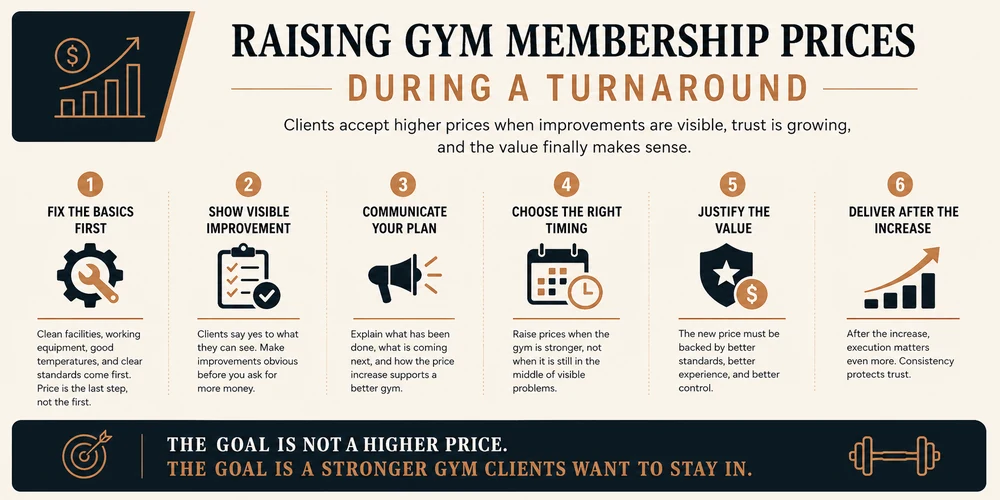
Clients are usually not against paying more for a better gym. They are against paying more before the gym feels better.
Do Not Raise Gym Membership Prices Before Clients See Value
The biggest mistake is raising prices before the client can understand why the new price makes sense.
If a gym is visibly neglected, the client does not experience the price increase as part of a turnaround plan. They experience it as a higher bill for the same problems.
Old equipment, peeling walls, ceiling stains, weak lighting, poor shower conditions, repeated maintenance issues, or inconsistent cleanliness all shape the client’s interpretation. The owner may see a future plan. The client sees today’s experience.
This is the gap that creates resistance.
A turnaround may be real. The plan may be serious. The investment may already be starting. But if clients cannot see improvement yet, the price increase can feel disconnected from reality.
New Management Creates Uncertainty First
New management can be positive, but it also creates uncertainty.
Owners may feel pressure. Staff may worry about new standards. Clients may wonder what will change, what will get worse temporarily, and whether the gym they know is becoming something else.
During a turnaround, clients often watch more closely than usual. They notice what is being fixed. They notice what is still broken. They notice whether staff seems more organized or more confused. They notice whether communication is clear or vague.
This is why a price increase during early uncertainty can be risky. It adds another emotional layer before trust has been rebuilt.
The client may ask a simple question: “Why am I paying more now?”
If the answer is not visible yet, the business has a problem.
The Client Does Not Pay for the Owner’s Promise
One of the hardest parts of a turnaround is accepting that clients do not pay for internal effort. They pay for the experience they can feel.
The owner may be working harder than ever. Management may be negotiating with vendors, planning upgrades, building budgets, fixing old problems, and trying to reverse years of neglect.
But most clients do not see that work. They see the entrance, the equipment, the locker room, the staff, the temperature, the cleanliness, and the daily experience.
This does not mean internal work is unimportant. It means internal work needs to become visible before a higher price feels reasonable.
Clients do not need to know every operational detail. But they need to feel that the gym is moving forward.
The Illogical Price Increase
An illogical price increase happens when the gym raises rates while the daily experience still feels weak.
The facility may still look tired. Equipment may still be outdated. Showers may still create complaints. Repairs may still be slow. Staff routines may still be unclear. Communication may still feel reactive.
Then the client receives a notice that membership prices are going up.
From the business side, the increase may be needed. From the client side, it may feel like the gym is asking for more before delivering more.
This is especially dangerous when renovation work is about to create inconvenience. Clients may see a neglected gym, a higher price, and construction disruption at the same time. Even if the long-term plan is good, the short-term experience may feel worse.
That is when some clients start thinking about other options.
Why Poor Timing Can Damage the Turnaround
A turnaround depends on cash flow, but it also depends on trust.
If a price increase causes too many clients to leave too early, the business may lose the revenue it was counting on to fund improvements. This can slow down the turnaround and create more pressure on the operation.
There is also a perception risk. Clients who leave during the messy stage may not judge the final version of the gym. They judge the transition. They remember the higher price, the inconvenience, and the problems that were still visible when the decision was made.
Some may say they will come back later. Some may not.
This is why timing is not a small detail. In a turnaround, pricing strategy and operational sequencing are connected.
The Logical Price Increase Starts Before the Announcement
A logical price increase does not begin with the email or front desk notice. It begins with the work clients can already see.
Before management asks clients to pay more, the gym should show that the direction has changed. The facility should look more cared for. Basic standards should feel more consistent. Staff should be able to explain what is happening. The most visible problems should not look ignored.
This does not mean every project must be finished. A gym does not need to become perfect before prices change.
But the client should be able to see progress.
Painted walls, cleaner windows, better lighting, repaired fixtures, improved shower areas, working equipment, stronger cleanliness routines, and clearer staff communication all create evidence. That evidence makes the price increase easier to understand.
Visible Progress Changes the Emotion of Renovation
Renovation can create frustration. Areas may be closed. Noise may increase. Schedules may change. The gym may look unfinished for a period of time.
But visible progress changes how clients interpret the inconvenience.
If clients trust the direction, temporary disruption can feel like part of improvement. If clients do not trust the direction, the same disruption can feel like another reason to leave.
This is why communication matters. Clients should not have to guess what is happening. They should know what is being improved, why it matters, and roughly how long disruption may last.
Clear communication does not remove every complaint. But it reduces uncertainty, and uncertainty is one of the biggest enemies of a turnaround.
Hidden Investment Still Needs Visible Proof
Some of the most important turnaround work may be invisible to clients.
Budgeting, vendor coordination, maintenance planning, staff documentation, access systems, insurance issues, cost controls, and operational routines may all be necessary. But they do not automatically make the client feel that the gym is worth more.
Hidden work protects the business. Visible work protects trust.
This is why projects such as gym equipment modernization matter so much in a turnaround. Equipment is not just an asset on the floor. It is one of the clearest signals clients use to judge whether the gym is improving.
The same applies to facility recovery. When showers, locker rooms, or basic comfort areas improve, clients feel the change directly. That is why Men’s Shower Room Renewal can support trust before and after the workout.
When the Gym Earns the Right to Charge More
A gym earns the right to charge more when the client can see that the experience is no longer the same.
This does not require luxury. It requires visible control.
The equipment should feel more reliable. The facility should feel cleaner. Communication should feel more professional. Staff should seem more aware. Problems should be handled with more consistency. The client should feel that standards are rising.
At that point, the price increase is no longer only a business request. It becomes easier for the client to connect the higher price with a stronger gym.
The client may still not like paying more. But the increase can feel logical.
A gym earns the right to raise prices when clients can see that the experience is no longer the same.
How to Announce a Price Increase Without Sounding Desperate
The announcement should not sound like the gym is asking clients to rescue the business.
Clients do not want to feel responsible for poor past management, delayed maintenance, weak budgeting, or ownership pressure. They want to understand what the change means for them.
A stronger announcement explains the value clearly. It should connect the price increase to visible improvements, better standards, continued investment, and a more reliable experience.
The message should be calm, direct, and specific. It should avoid vague language like “due to rising costs” unless the gym also explains what clients are getting in return.
The tone matters. The gym should sound organized, not desperate. Confident, not defensive. Clear, not apologetic.
Staff Must Understand the Message
A price increase is not only a management decision. It becomes a front-line conversation.
Clients may ask staff why prices are changing. They may complain. They may compare the gym to cheaper competitors. They may ask whether the new price is worth it.
If staff are not prepared, the message can become inconsistent. One employee may overexplain. Another may sound defensive. Another may say they do not know.
This creates more doubt.
A stronger staff training system helps the team communicate clearly, stay consistent, and explain the change without turning every conversation into a conflict.
Price Comparison Starts Before Experience Comparison
When prices rise, some clients will immediately compare the gym to cheaper options.
This is normal.
At first, the comparison may be simple: one gym costs less, another costs more. But the real comparison is not only price. It is the total experience.
A lower price may come with more crowding, longer waits, weaker staff capacity, less predictable cleanliness, fewer comfort standards, or less control over the environment. A higher price must be supported by a better daily experience.
This is why a turnaround cannot rely on explanation alone. The gym must make the difference visible.
Control Matters More Than the Price Itself
Clients can accept different price levels when the experience feels controlled.
They may accept a higher price if the gym feels cleaner, safer, more organized, and more reliable. They may reject a lower price if the environment feels chaotic, neglected, or frustrating.
This is the real pricing lesson during a turnaround. The price does not stand alone. It is judged against the client’s daily experience.
If the experience feels weak, even a small increase can create resistance. If the experience feels stronger, a larger increase may feel more reasonable.
That is why pricing cannot be separated from operations.
The Right Timing Protects the Turnaround
Raise gym membership prices too early, and the business may create resistance before trust has been rebuilt. Wait too long, and the gym may not have enough revenue to support the improvements clients expect.
The right timing is between those two risks.
It comes after clients can see real progress, but before the business waits so long that improvement becomes financially harder to sustain.
A good turnaround does not raise prices simply because the business needs money. It raises prices when the gym can show why the higher rate belongs to a stronger experience.
The goal is not just to raise gym membership prices. The goal is to build a gym that clients understand, trust, and want to stay in.
Planning a Membership Price Increase?
Make the Higher Price Part of a Stronger Experience
If your gym needs more revenue but the member experience is still changing, I can help identify the operational priorities and build a practical sequence for the turnaround.
No pressure. The first conversation is used to understand the situation and determine whether the project is a practical fit.